Friday, May 20, 2016

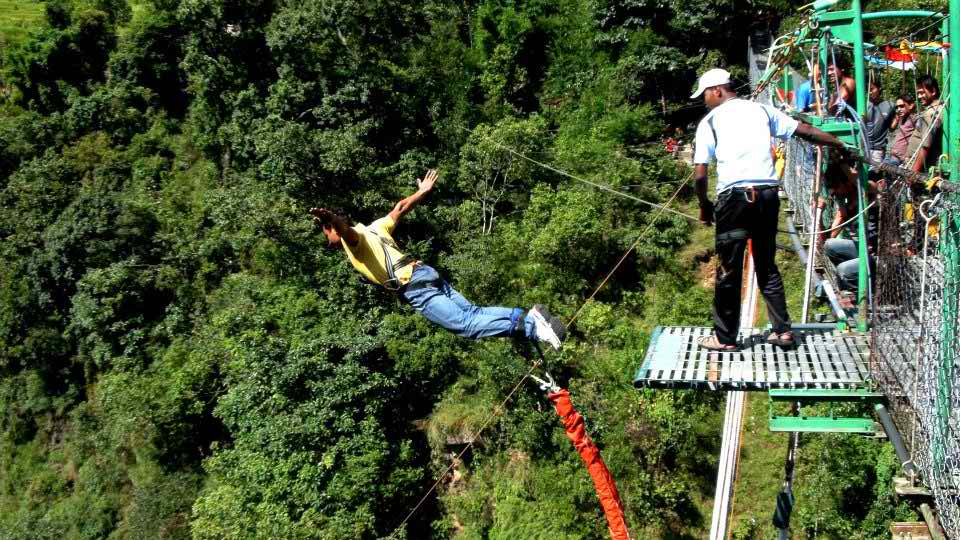
Bungy Jumping As Stunts

While we may never know for certain which is actually stronger--  the media's influence on the public, or the public's influence on the media--  but there is no way to discount the fact that the influence in both directions is very strong indeed.  The general population, especially the younger people, are greatly influenced by what they see on on the movie screen, and they wish to emulate their favorite stars.  The actions which the celebrities take part in, American youth wants to take part in also.  And bungy jumping is no exception!

On the other hand, what is presented in the media often clearly mirrors the behaviors and the lifestyles of the American public.  For better or for worse, a large part of American entertainment is based on mimicking their audiences.  If it is popular amongst "regular folks," presenting it on the movie screen tends to make it even more popular.  

One of the most well-known recent movie stunts showed James Bond jumping over the edge of a dam in "GoldenEye."  Bond's bungy jump stunt was for real, not merely a movie effect.  Bungy jumping has become an interesting stunt in modern movies, as evidenced by the growing number of bungy jumping companies which offer special training to those who plan to do similar stunts in films.  On the Hollywood scene there have always been actors who specialized in movie stunts in general, but seeing more doing bungy jumping stunts shows how popular this sport has become.  

The James Bond character, stunt-doubled by Wayne Michaels, may have performed one of the most recently popular bungy jump stunts, but is far from being unique.  Even thought it was voted as the best stunt ever filmed did not distract others from attempting the same feat;  perhaps it even assisted others in wanting to meet or even outdo what Wayne Michaels did.  

Bungee America, which offers great bungy jumping experiences to all who wish to try the sport, is also Hollywood's number one bungy stunt company.  Since 1996, they have assisted in the bungy jump stunts for no less than forty-five Hollywood films.  The first, made in February, 1996, starred Arnold Schwarzenegger in his movie "Eraser."  In this movie, which involved falling sixty-five feet and doing a back-flip, Schwarzenegger did not use a double, but performed the stunt himself.  This is quite impressive, and surely a positive influence on the fans, because most stars do use doubles in their place for such dangerous stunts.  It undoubtedly has prodded his already-large number of fans to have an even deeper respect for this actor.  

Bungy jumping is clearly a sport which is here to stay, and its appeal in the media proves it.  The more that Hollywood presents it as stunts in their films the more the general public will want to take part;  and the wider the public interest and involvement in bungy jumping, the more commonplace it will continue to be on the movie screen--  for daily life mirrors the media, and the media mirrors daily life.  

Bungee or Bungie Jumping

You've seen it, but perhaps are still unaware of the controversy surrounding bungee jumping.  No, I'm not talking about the obvious discussion surrounding the safety of this sport.  What I want to present in this article is the origins of the word 'bungee'.  Actually, there is some controversy as to whether it is bungee or bungie jumping.  My word processor's spell check feature likes the 'bungee' version, but as we shall soon see, this may not actually be the historically correct spelling.

While the sport of bungee jumping was brought to the forefront of the modern public's attention by a BBC documentary in the 1950s, the term bungee was in use prior to this time.  The natives whose religious ceremony has evolved into this sport did not come up with this term, as some might suspect.  Looking back into the dictionaries of the past and the etymology of the word, we can find this disclaimer: origin unknown.  While this may be the official stance, let's take a closer look at the word, it's historical uses, and possible origins.

The first documented use in Western culture of any variation of the word bungee appeared in a novel called 'Tall Ship' in 1915.  The spelling of the word in this novel was actually 'bunje', and was used as a nick-name for a physical training instructor on the ship.  It just so happens that the term also referred to Indian rubber, or rubber that was exported from India at the time.  Perhaps the nickname was used as a reference to the stretching performed as part of the instructor's training regimen, as similar to the stretching of rubber from the rubber tree.

The next variation occurs in 1934, in a journal called the 'N&Q'.  The statement is made referencing the use of the term 'india-bungie' or 'bungie' in the school classrooms referring to soft rubber used as an eraser.  Interestingly enough, the reference is to the word's usage some fifty years prior to the publication date, which would be back in the 1880s.  Perhaps we are getting closer to the origin?  Can we come to a conclusion yet as to whether it is bungee or bungie jumping?

Let's look a bit closer at the idea that the word comes from an Indian rubber produced at the turn of the 20th century.  In the country of India, Hindi was and still is the native language.  If we look into the Hindi language, we can find some idea as to the origin of this strange word.  In the early 1800s the term 'bungy' and a variation, 'bhangi' was used in a derogatory manner towards house servants.  In fact, during this time, the term described a low caste, usually employed as sweepers.  They were considered among the lowest servants in the home.  Could it be possible that the name for this group was later given to a product that they began to produce?  If these servants were put into the fields to harvest the sap of rubber trees, it would not be a far stretch to see their nickname associated with the product of their toil.

Whatever the case may be, today we see two primary spellings.  Whether you participate in bungee or bungie jumping today may have more to do with where you go for your jump.  Those in the northern hemisphere seem to prefer the term 'bungee', while those in the southern hemisphere stick with the more traditional 'bungie'.

Bungee Jumping Safety

Bungee jumping safety should be at the top of anyone's priority list if they plan to engage in the extreme sport of bungee jumping.  It's not every day that someone jumps off of an object 100 or more feet in the air, attached only by a large rubber rope.  There are many, many things that can go very, very wrong in bungee jumping.  Bungee jumping safety is the art and practice of making the sport as safe as possible.  This is especially true with commercial ventures that are open to the public.  Such places may serve thousands of patrons every year.  One fatality can be enough to put them out of business for good.  They take bungee jumping safety very seriously ... as well they should.

The first thing you should know about bungee jumping safety is that each organization or group that conducts bungee jumping is referred to as a 'club'.  It is important that you find out if the club you are jumping with is certified through some safety governing body.  In most countries, there is a government safety organization that regulates public safety standards in various environments.  In the United States, for example, we have OSHA, the Occupational Safety & Health Administration, who oversees all workplace safety issues.  In Great Britain, there is the Heath & Safety Executive (HSE), whose functions are very similar.

However, there is an organization devoted strictly to the safety of bungee jumpers everywhere.  The organiztion is known as BERSA, the British Elastic Rope Sports Association.  BERSA has put together a code of practice in conjunction with the HSE, as a standard for safe operations when conducting bungee jumps.  While member clubs and companies sign up voluntarily to follow the guidelines, there is no legal requirement for those who decide not to.

Another aspect of bungee jumping safety is the actual equipment used in bungee jumping.  While there is a variety of methods and equipment that can be used, regular inspection is important.  It is highly recommended that each and every piece of equipment be triple checked after every single jump.  After all, if one piece of equipment fails, it can cost someone their life.  Most commercial operators do just that.  Attachments at the platform are checked.  The bungee cord itself is checked for any damage.  Each jump is logged, as each type of cord has a known life expectancy.  The weight of each jumper is checked, and usually written on one hand of the jumper, so it can be double-checked as well.  Every detail and element of physics must be correct before a person jumps off of the platform.  Once you jump, there's no coming back - there can be no mistakes.

There are a number of injuries that can be sustained during a bungee jump.  From minor bruising, to broken bones, to death, all of them can be prevented with proper bungee jumping safety.  As in any extreme sport or occupation where there is no second chance, safety should always be the number one priority.  Bungee jumping is no different.  

Bungee Jumping Equiqment

Bungee jumping equipment comes in a variety of shapes and sizes.  In fact, each piece of the equipment used in bungee jumping can have quite a few variations.  It is a good idea to familiarize yourself with the equipment used in bungee jumping before you participate in a jump.  This way you will know what to look for and what type of setup you would like best.  While there are many different types of platforms and retrieval equipment, for the purpose of this article, we will look at two things that will affect your jump the most - the bungee cord, and the harness.

When talking about bungee jumping equipment, the bungee cord is one of the most important items.  There are several variations on the type of cord that is used in bungee jumping today.  There are braided cords, unbraided cords, pre-stretched and un-stretched, natural rubber, mil spec, and the Euro cord.  These are the major variations in the bungee cord used in today's bungee jumping sports events.  Let's take a minute to look at the characteristics of each one of these cords, and the impact that it has on the end user:  the bungee jumper.

First, there is the military specification cord (or mil spec), which is manufactured to meet the requirements of the U. S. military.  Of course, the military uses it to tie down equipment, not jump from bridges and other tall objects!  However, because of the rigorous and standardized testing of the mil spec, these cords work well for bungee jumping.  When using mil spec cords in bungee jumping, they are usually grouped together to form a set, as one cord can typically hold around 200 pounds of weight.  Each cord has a protective sheath on it to prevent dirt and foreign objects from abrading the cords.  The downside to this is that it is not possible to inspect the ends of the cords for fraying and / or signs of failure.

Some bungee cords are pre-stretched.  This prevents the cord from stretching as much during the actual jump, which provides more of a 'jerking' action and a shock as the jumper reaches the end of the cord length.  These are used mostly in the northern hemisphere.  In the southern hemisphere the commercial proponents of bungee jumping tend to use a natural rubber, un-stretched and unbraided cord.  This provides for a lot more 'bounce' and a more smooth experience at the bottom of the jump.  While these natural cords do not last as long as the mil spec cords, they do provide a much more comfortable jump for the average user.

The next piece of bungee jumping equipment that you should inquire about is known as the harness.  There are two main types of harnesses - the leg harness and the body harness.  The leg harness usually consists of a towel wrapped around the ankles with webbing tied around this in a special knot.  The towel provides padding to help prevent injury to the ankles.  The webbing is then attached to the bungee cord.  The body harness is very similar to a climber's harness, and in fact, is many times the same thing.  The most important aspect of the harness is how it attaches - if it is secure - to the bungee.  Some accidental deaths have occurred when the bungee cord was attached using climbing carabineers instead of specialized equipment.  It can definitely be said that bungee jumping equipment has come a long way since the vines on Pentecost Island!

Bungee Jumping Culture

There is something about an individual that is willing to jump from a high place, attached to a rubber band.  This modern extreme sport, known as bungee jumping, seems to have it's own culture attached to it.  It's almost ethereal, hard to put your finger on it, but it is there.  Perhaps it comes from the past, or is a morphing into a new spiritual experience, but the bungee jumping culture can be seen and felt.

So what is the bungee jumping culture?  Where did it come from?  Where is it going?  The origins of the sport itself gives us a clue as to where the bungee jumping culture came from.  Originally a religious ritual used on the South Pacific island of Pentecost to appease mother earth, it was supposed to proved for a good yam crop.  It was also a demarcation, a rite of passage, for young boys to become known as men.  Since as long as anybody can tell, these natives have conducted this ritual every spring, literally for thousands of years.  The prevailing culture of the original land divers was definitely a spiritual one.

Re-discovered in the 1950s and promoted heavily in the modern world during the 1980s, bungee jumping has grown by leaps and bounds.  The modern bungee jumping culture doesn't consist of primitive natives trying to appease the mother earth.  However, there is a back-to-earth element to this extreme death defying outdoor sport.  It provides a thrilling adrenaline rush that is next to nothing else on earth.  Perhaps space travel could rival this effect, but I doubt it.  The bungee jump goes beyond the limited religious and cultural conflicts of our modern day, and appeals to something more primitive, more basic.  The modern bungee jumping culture is a multi-ethnic, multi-generational, and multi-socio-economic group, all looking for the thrill of their lives.

So what does the modern bungee jumping culture look like?  It defies logic.  Both young and old alike flock to bungee jumping events.  There is simply a mystique that permeates this sporting event like no other.  Back to mother earth, defying death, and telling the tale - all of these are the bragging rights of successful bungee jumpers.  They all share in common this aspect of the sport - survival.  Jumpers face a primeval fear, the ultimate loss - death, and overcoming that fear to complete a jump.  There is a sense of accomplishment and victory that goes beyond mountain climbing and other extreme sports. 

Taking the back-to-nature theme to the extreme, there is a new movement within bungee jumping called nude bungee jumping.  It typically appeals to the green back-to-earth movement, as well as the frugal bungee jumpers.  Commercial bungee jumping outfitters usually provide a discount, or even a free jump, if someone decides to go the full monty.  This type of jump is usually done with a partner, for a spiritual bonding that goes beyond the everyday realm.  This is yet another evidence that the bungee jumping culture is evolving beyond normal boundaries, and we have yet to truly see what it will become.

Bungee Jumping Clubs

So you want to go bungee jumping, and you are trying to figure out where to get started.  Or, perhaps you are a seasoned jump veteran, and you are looking for others to start a jumping group together.  Either way, you are really looking for the same thing: a bungee club.  Bungee jumping clubs have come into existence over the last few decades as a result of the prominence and massive expansion of the bungee jumping industry.

A group called the Dangerous Sports Club could be considered to be the first bungee jumping club.  This group, from Oxford and London, were active in a variety of extreme sports adventures from the late 1970s through the 1980s.  The club is credited with the invention of the modern bungee jumping craze.  Their first jump took place on April 1st, 1979.  The club was very active during their heyday in the early 1980s.  Easily the most famous member of the Dangerous Sports Club was Graham Chapman, of Monty Python fame.

Since that time, bungee jumping clubs have grown in popularity as well as quantity.  There are bungee jumping clubs on virtually every inhabited continent of the globe.  The fact that this extreme sport has taken such strides in popularity is evident from the number of clubs and the amount of jumpers who make the plunge every year.  There are two primary bungee jumping safety organizations that operate as certification entities today.  One is the United States Bungee Association (USBA), the other is the British Elastic Sports Association (BERSA).  These organizations would be a good starting place to find a bungee jumping club, because they keep track of who is certified by their respective organizations.  This is good, because you can be assured that the club is operating with safety procedures strictly enforced.

Some experienced bungee jumpers may want to start their own club.  However, this is a big endeavor, and they should consider all of the steps necessary to start a club before they get started.  Just a few of the things needed will be considered here.

First, in order to start a bungee jumping club, you would want to write and document your 'business plan', so-to-speak.  This would document your project and would provide something for you to give out to prospective investors and concerned government agencies.  You will need to acquire financing in order to pay for equipment, insurance, experienced crew, jump location, etc.  Once contracts are in place for the crew, location, etc., you will want to get any needed governmental permits.  Once all the paperwork is in place, you can begin construction of your jump site.  After testing with sandbags, and your crew, you will finally be ready to start promoting your bungee jumping club.  As you can see, these are only an overview of the steps required.  Even this short list presents a formidable task to starting a club.

It is probably best to start by joining an existing bungee jumping club, and drawing from their experience while you grow your own experience.  This would provide the springboard needed to launch your own bungee jumping club in the future.

Bungee Jumping Accidents

Bungee jumping is, by it's nature, a dangerous sport.  There is no denying that fact.  However, modern manufacturing methods and safety practices have made the sport much safer over the past decade.  It is certainly safer than the land diving of the South Pacific natives.  Unfortunately, even with all of these advances in the sport, bungee jumping accidents still occur.  In this article we will examine what can happen as a result of bungee jumping.

The most severe bungee jumping accidents can actually be fatal.  Most of the fatalities that have occurred in bungee jumping occur as a result of head trauma.  Miscalculation of the length of bungee cord necessary to complete the jump safely has resulted in several deaths since the sport became a public phenomenon in the late 1970s.  One of the most infamous deaths from bungee jumping occurred during practice for the half-time show of Superbowl XXXI, in 1997.  Laura Patterson, who was practicing with members of her professional team, died upon impact when she jumped from the top level of the Louisianna Superdome.  The accident was blamed on the bungee cords being handled incorrectly.  The half-time show was subsequently cancelled, and a tribute to Laura was performed instead.  Other deaths have resulted from people actually coming loose from the ankle harness.  This has led to the common practice of using a body harness as a back-up safety precaution.

Bungee jumping enthusiasts will be quick to point out, however, that there are only a handful of deaths from among millions of jumps that have been performed over the last few decades.  Even though this is true, there are many other types of bungee jumping accidents that can occur if strict safety guidelines are not followed.  Rope burn, pinched fingers and bruises are among the most common injuries suffered from bungee jumping.  While these may not be attributable to actual bungee jumping accidents, they can be considered an adverse side-effect by most people.  

More serious than sprains and bruises are the possibilities of other bungee jumping accidents, such as severe eye trauma, dislocation, back injury, and even broken bones.  These are not highly publicized events, but they do occur nonetheless.  In the case of the eye trauma, increased pressure in the eye an cause a blood vessel to burst near the retina.  This results in blurred vision or loss of eyesight completely.  Although it sounds horrific, this is only temporary, until the body repairs the damage done.  Of more concern would be back injuries and broken bones.  In the case of back injuries, a dislocation or strain on the spine can cause a lifetime of pain and suffering.  That is something to take into account when weighing the risks of bungee jumping.  

Bungee jumping accidents do occur, but they can be minimized by following established safety procedures.  It is up to you to ask the right questions.  It is up to the commercial company or club to ensure they have the right equipment and trained operators.  Bungee jumping can be fun, and does not have to involve serious injury if done correctly by trained operators and jumpers.